


On January 20, 2025, Former President Donald Trump will once again become President Trump. Some clients have contacted me about whether their accounts should be altered as a result or whether we will be making any changes in anticipation of negative stock market reactions.
While we always welcome a chance to re-evaluate client accounts, we haven’t recommended making any changes because of the election results. There is no historical evidence that stock market returns can be predicted based upon which person or political party wins the election.
Bespoke Investment Group published a study this year on “Investing and Politics.” AMG Funds distributed it. The study discussed the relationship between which party and President won the the Presidential election and future investment returns.
The table below uses data from that study to detail the Average Annualized Return of the Dow Jones Industrial Average during the Presidential term for the fourteen Presidents who have served since 1945. The two best returns were for Democrats but Republicans held the next five spots. The returns during President Trump’s first term were the fifth highest. President Biden currently ranks second.
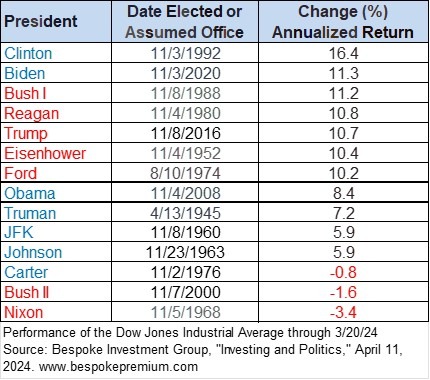
The spread of returns for different Presidents was quite wide and there did not seem to be a direct relationship to political parties. We don’t see any meaningful pattern, certainly nothing that could be used to predict returns.
The stock markets performed well during President Trumps first term. The markets may or may not do well during his second term. No one knows.
Bespoke’s study is based upon historical data and past performance is no guarantee of future performance. But the complexity, substantial number of variables and the influence of Federal Reserve make it difficult to impossible to predict stock and bond market returns based upon the party or person that wins.
Another Example
There is no better example of how difficult it is to predict future stock market returns than the Covid Pandemic.
Suppose that on January 1, 2020, a hypothetical group of Wall Street investors knew, without any doubt, that the Covid Pandemic would occur, the date, that the world economy would shut down and that the U.S. economy would be particularly hard hit. There is no question what they would have done; they would have sold stocks and resolved not to buy stocks again until a Covid cure became effective and the economies of the world began to recover.
That would have been a mistake. Stock market prices began increasing before there was a Covid cure and before the economic recovery began. Stock markets recovered so quickly that by mid-August they had recovered all losses.
The graph below illustrates the “Covid market.” A major market decline (a Bear Market) began late in February. For example, by March 24, 2020, S&P 500 Index funds had declined 34% from their February highs. Based upon the unprecedented level of worldwide economic damage, most investment prognosticators expected the market to continue to decline.
But by the end of 2020, S&P 500 Index funds had increased 17.5% for the year. Returns were also excellent in 2021. By December 31,2021, S&P 500 Index funds were 53% higher than before Covid hit the U.S. The hypothetical investors mentioned above could have made a substantial profit by just staying invested, by doing nothing.
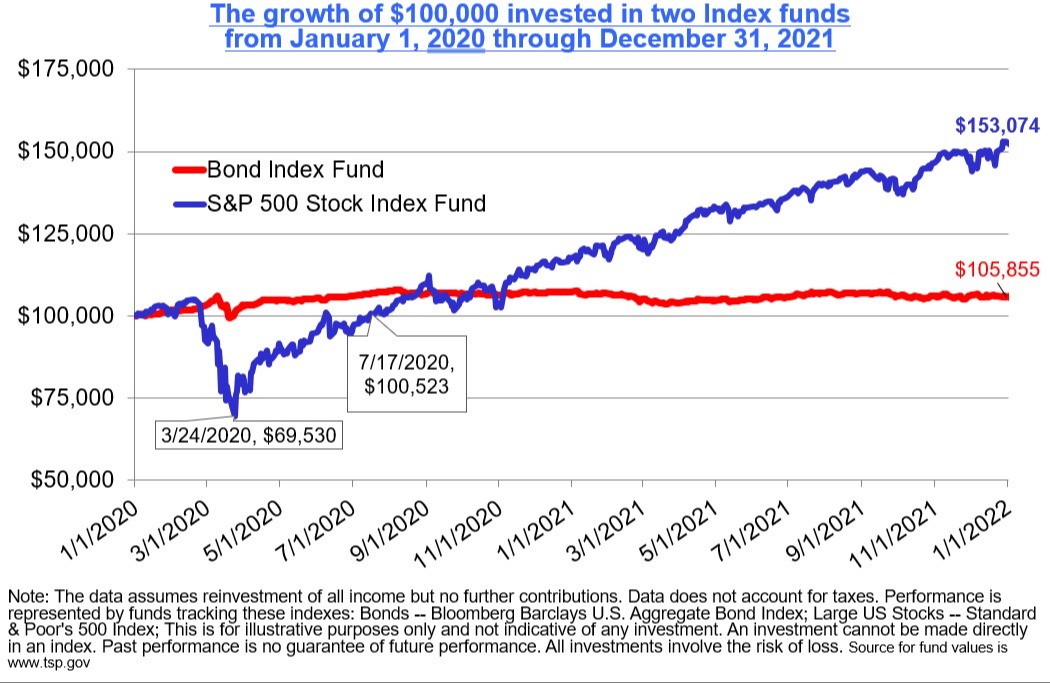
Our hypothetical investors probably would not have gone back to stocks when they were only down 34%. Because at that point, the Bear Market’s decline and length were both below the average Bear Market. But the economic destruction was probably the greatest since the Great Depression, when the market declined 83%. See table below.
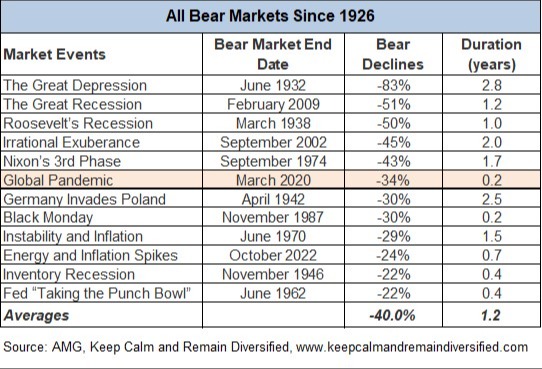
If knowing in advance that the Covid Pandemic was going to happen and how bad the economic destruction would be was not enough for investors to easily profit, why would other events be any different?
What Can You Do During Volatile Markets?
What you should do is an important question. My firm frequently faces that question because we manage investments for our clients. We only act after changes in the markets, a client’s personal situation or for other reasons. We don’t act based upon forecasts. We recognize that there are times when doing nothing is a better strategy than acting.
Warren Buffet, probably the world’s most successful long-term investor, likens investing to being a batter in a baseball game. Baseball batters do not have to swing at every ball pitched to them. Tennis players have to return every ball but baseball batters can ignore a pitch that will be difficult or impossible for them to hit. They can wait for the easier to hit balls and only swing at those.
Buffett says investing is the same way. He doesn’t need to buy or sell investments at any particular time. His firm only acts when they decide that a worthwhile opportunity exists. They wait for the “easy pitches.”
Individual investors and investment firms can do the same. We can ignore poor opportunities, even if others are acting on them. We don’t need to act on forecasts. We can wait for the easy pitches.
Periodic declines, including Bear Market declines greater than 20%, are always in our future. They are a normal part of stock market cycles. After significant declines occur, it is time for you or your Investment Manager to review your accounts and determine whether changes are needed.
If you are nervous or think changes to your investments are needed, then we should meet. You can directly schedule a Zoom meeting with me by clicking on my Calendar link: https://calendly.com/art-d39n/30min