


I would not argue with anyone saying that the last eight weeks were not only different but unprecedented. The amount of change, confusion, restructuring of government agencies, chaotic firing of Federal employees and contractors, arguments with allies, poorly qualified nominees, fluctuating and confusing tariff policies and threats by the President and his administration clearly qualify as unprecedented.
And no one knows whether it will get worse, better or stay the same.
The personal costs inflicted upon Federal Employees and contractors have been enormous. And personal costs for all Americans may increase if damage to the U.S. government causes delays in the payments of Medicaid, Medicare, Social Security and Federal employee salaries and pensions.
You are naturally worried about what it means for your TSP and other investments and whether changes should be made. Specifically, how will political and resulting economic events affect the markets and should anything be done now?
Unfortunately, no one has been successful at forecasting market returns consistently, even during more normal periods. And our current situation is not normal, which makes forecasting more difficult.
Knowing what is currently happening does not tell us how the TSP funds will perform in the future. However, looking at what has happened in the past may give us some clues about what to expect over longer periods of time. Past performance in no guarantee of future performance but it is informative.
Before discussing past and current returns, lets look at what TSP accounts are actually invested in.
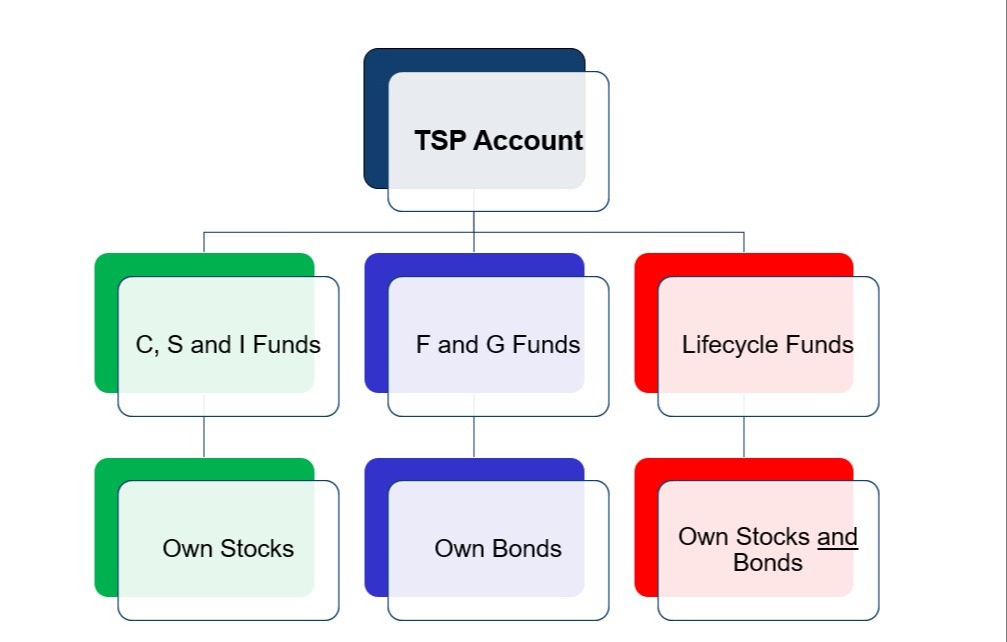
The TSP Funds are a way to own different types of stocks and bonds
It is important to understand the difference between investments and ways to own investments. Investments available in the TSP are stocks, bonds and the G Fund. The TSP Funds are a way to own different types of stocks, bonds and the G Fund.
There are three levels to your TSP investments.
- The TSP account.
- The funds you invest in.
The stocks and bonds owned by those funds.
The share prices of the TSP Funds go up and down because the stock and bond markets go up and down.
Current TSP Returns
The values of the stocks and bonds you own in your TSP account vary with the financial markets where the stocks and bonds are traded. The stock and bond markets are influenced by many factors, including politics, and the economy, interest rates, monetary policy, company earnings, tax policy, technological developments, regulations, actions by other nations, commodity prices, wars, pandemics, natural disasters, climate change and inflation.
As of Friday, March 14, current TSP returns can be used to justify both of the following statements:
- Since Donald Trump was elected, TSP returns increased or decreased by small amounts
- Since Donald Trump was elected, the TSP funds have experienced a lot of volatility, increasing and decreasing in value by an unusual amount.
Actually, both statements make sense. Let’s look at the five traditional TSP funds (G, F, C, S and I) to see why.
Here are the total returns for the funds since President Trump was elected on November 5, 2025.

Not very exciting. There were small increases and decreases that normally would not cause much comment. The bond funds increased a small amount, the U.S. stock funds decreased and the foreign stock fund increased.
For excitement, lets looks at the ups and downs of the Funds over that same time period. Those ups and downs are called volatility. My blog explaining volatility is available here.
As you can see in the following graph, since the election, there was a lot of volatility in the prices for TSP fund shares. The graph assumes a $100,000 investment in each of the five funds on Election Day.

We see a lot of volatility, even though the changes in total return (differences between beginning and ending values) were small. Looking at individual Fund volatility, the:
- G Fund (short-term government bonds) showed no volatility, just the usual steady but small increases.
- F fund (intermediate corporate and government bonds) increased, decreased and increased again.
- C Fund (stocks of large U.S. companies) increased, decreased, increased and then decreased.
- S Fund (stocks of small and medium sized U.S. companies) was down, up, down and then up.
- I Fund (stocks of foreign companies) was down, then up, then down and then up again.
Future Returns
What we would like to know is how current political and economic events will affect the markets and whether you should make any changes to your TSP and other investment accounts.
Unfortunately, it is not a question for which anyone has a reliable answer. Even if we knew what was going to happen politically and to the economy, we wouldn’t be able to forecast market returns.
The Covid Pandemic illustrates this. In addition to massive suffering and loss of life, the Covid Pandemic caused the greatest economic catastrophe since the Great Depression. The U.S. economy shut down. The economies of most countries shut down. First quarter U.S. economic output (as measured by Gross Domestic Product) declined -8.2%. Stock markets declined more than 30% at one point. For instance, the TSP C fund was down 34%.
But the U.S. stock market crash was short lived; at the end of 2020, the C Fund (and other S&P 500 Index funds) were up 18%. It was a great year for other U.S. stock markets as well.

If knowing in advance that the Covid Pandemic was going to happen and how bad the economic destruction would be was not enough for investors to easily profit, why would other events be any different?
Other events are not different. Just like the Covid Pandemic, even if we know what is going to happen politically and economically, we still would not know what was going to happen to the stock and bond markets over the next year and after that. And no one has been successful at forecasting market returns consistently, even during more normal periods. And our current situation is not normal.
None of this is meant as a prediction. It’s simply a recognition that uncertainty is always part of investing. The future is never clear but the urge to "do something" in the face of chaos often leads to worse outcomes than simply staying the course.
If history teaches us anything, it’s that panicking rarely paid off for investors. For well diversified and well managed Portfolios, staying invested and diversified was the best strategy, even when the headlines were unnerving. Past performance is no guarantee of future performance but I don’t expect a different pattern in the future for long-term investments.
The TSP F, C, S and I Funds work best as long-term investments. Instead of trying to forecast declines, a better strategy will probably be to say invested in the allocation that you previously decided was appropriate. Boring yes. But boring can be good.
It is critical to stay invested, remain patient and stick to your plan. Your plan should include an appropriate allocation target based on your financial position, risk tolerance and investment timeline.
Don’t try to move into or out of the stock or bond funds in advance of expected changes in market values. Periodic declines in both the stock and bond markets are expected. When significant declines occur, you or your investment manager should review your Portfolio to determine whether changes are needed to return the Portfolio to the stock/bond allocation you desire.